Pendulum Clock Regulation in Polish Workshops
Regulating a weight-driven pendulum clock means aligning three independent variables: the effective length of the pendulum (which sets the theoretical beat rate), the escapement impulse (which keeps the pendulum swinging), and the crutch-to-escapement connection (which determines whether the tick is even on both sides of the beat). In Polish interiors — centrally heated in winter, humid in unheated rooms — these adjustments interact with seasonal barometric change more than in consistently air-conditioned spaces.
Establishing an even beat
Before adjusting rate, the escapement must impart equal impulse on each swing. Listen at the case door: a healthy longcase or wall clock produces two acoustically similar ticks per complete pendulum cycle. Uneven ticks usually indicate crutch misalignment relative to the pallet arbor, a bent crutch wire, or a pendulum rod not sitting square in the crutch fork.
On anchor escapements common in nineteenth-century Polish longcase clocks, the crutch fork should engage the pendulum rod without lateral play. A slip of paper between fork and rod, when the rod is centred, should drag evenly on both sides. If one side binds, the beat will favour that direction and rate adjustment at the pendulum bob will not correct the fault.
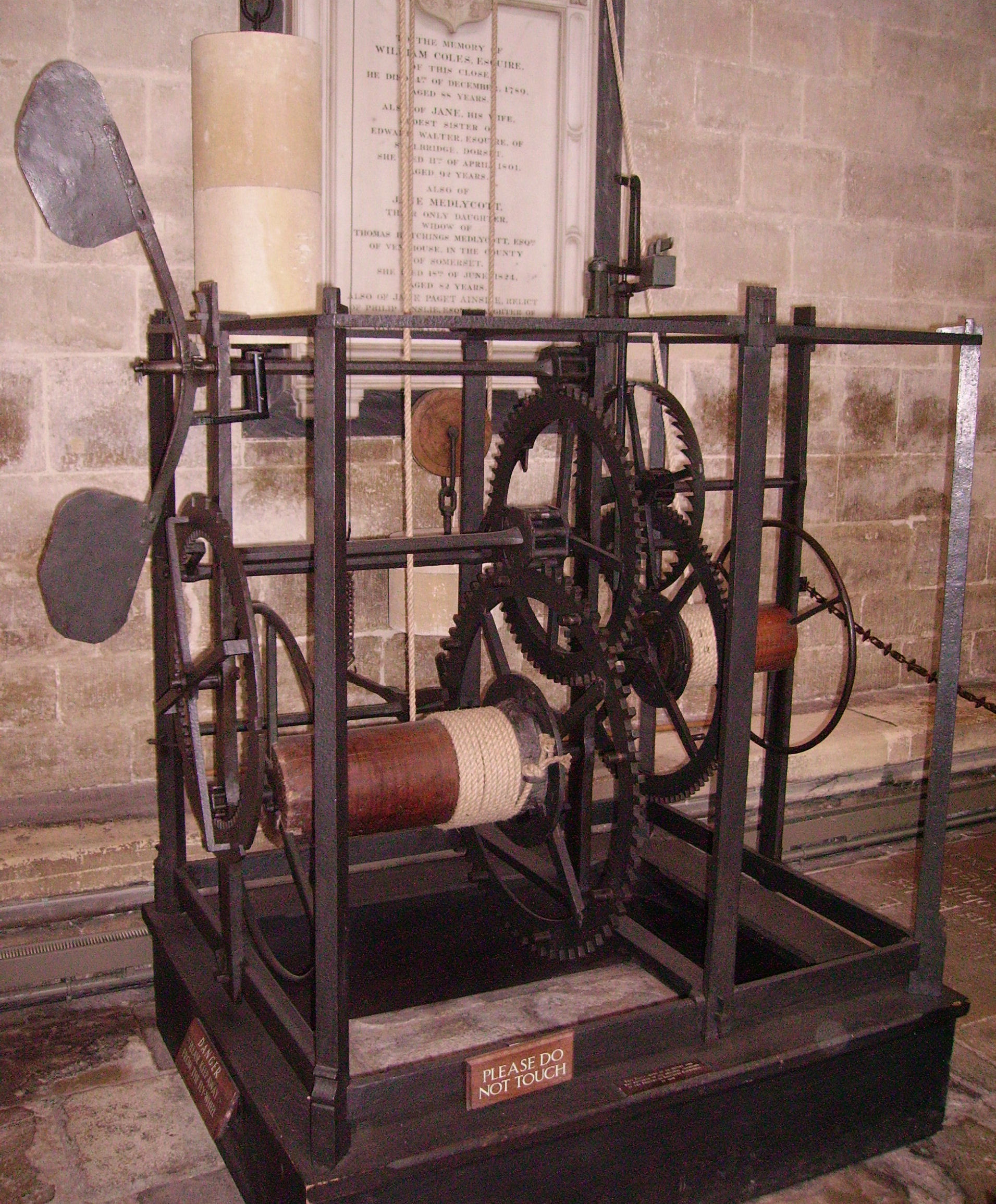
In museum documentation of the Salisbury cathedral clock mechanism — one of the earliest surviving weight-driven installations — the absence of a dial reminds that many historical movements were regulated by ear at the bell tower, not by a seconds hand. Modern restorers in Poland often replicate that listening step before touching the rating nut.
Rate adjustment with the rating nut
Once the beat is even, rate is adjusted by changing the effective pendulum length. Turning the rating nut below the bob upward (shortening the pendulum) speeds the clock; lowering the nut slows it. On a typical seconds-beating pendulum, a full turn of a coarse-pitch nut may alter daily rate by roughly one to two minutes, though the exact amount depends on thread pitch and bob mass.
Polish workshops often record rate against an external reference — a radio-controlled quartz clock or a calibrated mobile time source — over several days before declaring regulation complete. A single twenty-four-hour check is insufficient when the movement has recently been cleaned, because oil film on fresh pivots can change amplitude slightly as it settles.
Typical regulation sequence
- Level the case so the pendulum hangs true in the case throat.
- Confirm even beat by listening or by observing pallet recoil symmetry.
- Set the hands to a reference time and record start position of the minute hand.
- After seventy-two hours, note fast or slow error and adjust the rating nut in small increments.
- Repeat until daily error is within the target window for the owner (often under thirty seconds for domestic longcase clocks).
Suspension spring and temperature
The suspension spring at the top of the pendulum rod is a flexural pivot. A cracked or work-hardened spring causes irregular rate and visible wobble in the rod. Replacement springs are matched by thickness and length to the movement size; using a spring from a different calibre changes the effective centre of oscillation.
Brass pendulum rods and steel rods respond differently to temperature swings. In Polish parish churches where heating is intermittent, wooden cases breathe and interior temperature can fall overnight. Restorers sometimes document winter versus summer rate separately rather than forcing a single compromise position on the rating nut.
| Symptom | Likely cause | First check |
|---|---|---|
| Uneven tick | Crutch or fork alignment | Pendulum centred in fork |
| Stopping after a few minutes | Insufficient amplitude, binding pivot | Pallet lock, strike interlock disengaged |
| Consistent fast or slow | Pendulum length | Rating nut position |
| Irregular daily error | Suspension spring, loose bob | Spring fracture, bob screw |
Strike and time train interaction
On striking longcase clocks, the strike train must fully disengage before the time train receives uninterrupted power. A dragging strike can reduce amplitude and mimic a regulation fault. Before adjusting the pendulum, run the movement with strike silenced or weight removed from the strike side to isolate the time train.